Birds
Hazard appeared to have a special interest in birds. In 1858, he made a failed attempt to import English house sparrows to Rhode Island and Boston (Brewster, 1906), and wrote in a journal (1891) that he believed birds to be "'Spirit-like' and may, perhaps, be susceptible of influence of Spirits of departed Mankind."
As one might expect, he paid close attention to the birds on his travels. He noted the types and number of birds, as well as describing a few specimens in particular:
Atlantic crossing
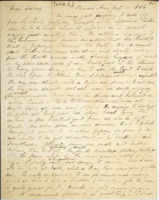
In this letter from July of 1856, Hazard recounts the birds he noticed while crossing the Atlantic from New York to Liverpool by steamship:
"Yesterday afternoon two small birds came on board together. The common sand piper or Stralyard birds, in R.I. the tips [illegible], a littoral bird common to all our streams + coast where it picks up insects by the water in the sand and stones . . . I have seen one shearwater this afternoon, the only bird except Stormy petrels for 2 days. He is like little gannett in appearance, gracefully skimming the surface of the water with which he rises."
Norway
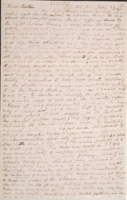
In this letter from June of 1857, Hazard observes the birds in the Norwegian forests, farms, and rivers:
"The woods, however, are perfect solitudes, save an occasional thrush not a bird, not a woodpecker ever, or creeper. The vales have more, there I saw one small hawk. Magpies are numerous and frequently sit on the roof of the houses as if cheriched. In England they are very shy. I see a few geese, and fewer chickens, at one farm house I saw what I supposed to be a domesticated capercazilia."
“In one of the lakes among the logs, I saw a Shelldrake with 9 young. They appeared very like our great pied “Merganser” we call “ Brake [at] home which sound like a Norske name, excepting two other ducks that looked large, these are all I have seen in these rivers."
Switzerland and Germany
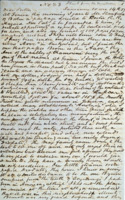
In this letter from October of 1857, Hazard notes some of the birds he saw in Switzerland and Germany:
"I saw a Lammergeier, grandly soaring, so near us, that I could recognize the bird by his white neck + head . . . Magpies abounded, I saw 20 together. They also lighted upon the houses. In flight they resemble our blue Jay, but I do not find them half as garrulous. There is another variety here, that is rare + more wild, appears to have some blue plumage . . . I saw a large Hawk, and in a break of the Danube (where many fish of considerable size seem to be) saw 9 wild ducks, a sight more pleasing than all the marble muses I have seen.”
Hungary and Serbia
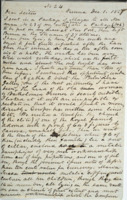
In this letter, Hazard remarks on the size and number of the birds he observed while traveling down the Danube:
"There are plenty of gulls, Rooks, and thousands of wild Ducks that look like mallards of large size . . . Eagles, or Hawks of immense size appear to be numerous. I have seen several, sometimes 2 or 3 at a time. I saw a couple of great spotted Divers to day (Loons) most of the wild Ducks, I find to be mallards . . . The Wild Ducks are very numerous and at this moment a thousand are near us and there are Eagles to feast upon them."
Israel
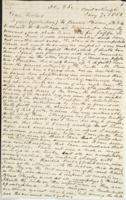
In this letter from January of 1858, Hazard describes the multitude of birds he observed:
"[There are] great numbers of many kinds of Hawks. By the shores of ponds little littoral birds of snipe family similar to ours. The country swarms with Myriads of B small for birds. The spring is just opening on the plain by the Sea and beautiful swallows are numerous. Jerusalem being 1500 feet above the Mediterranean is till cold and tempestuous. The Rook, Hooded Crows + Lapwing are there common. Larks, Starlings, and a sort of Magpie I recognized. A bird rather larger than our bobolink, of beautiful form, is purely white, excepting his jet black wings. I heard Sparrows in Jaffa and at the convent, but saw none."
Brazil
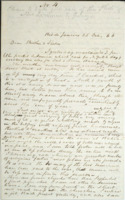
In this letter from December of 1866, Hazard observes a few birds in Brazil and mentions a theory of his regarding birds of prey:
"The day was considered hot by the people here, and the swan, the only I have seen in Brazil, sat [under] in the water under dense herbage his neck coiled on his back like a rope, taking the virticul sun very coolly, after the verdant roof had done with it. And so a cormorant of some sort, who stood on the bank in the river mouth + wings every feather distended, panting a prayer, pitiful to witness. By the way I find a [illegible] fishing bird here has taken his prey in the same manner with the Solon Grouse or Gannet, and is so far as is seen, a confirmation of my magnitie theory of the manner of birds taking their fish + which applies also to some other birds of prey. I have tried for years to get naturalists to examine the seagull."