Cuttings and sketches
Hazard often enclosed cuttings of plants in his letters, including flowers, leaves, ferns, and occasionally even seeds. In the letters themselves, he routinely drew sketches to illustrate his verbal descriptions. Below are some excerpted highlights:
Wales and England
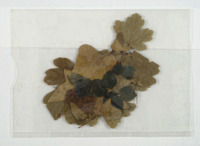
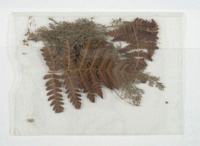
Hazard included these flower and leaf cuttings from his June 1856 travels:
"I enclose some blue flowers from the apex [of Holyhead], whence I had a fine view of the mountains of Wales."
"In one part [of Alton Gardens] the trees are named, among these I saw “Pinus Rigida” “Pitch Pine New England.” I enclose a few leaves, on chewing I found them almost flavourless, though the tree looks healthy."
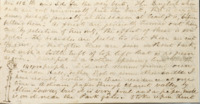
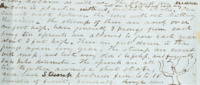
Letter No. 19 also included a sketch illustrating the unusual result of trimming oak trees:
"The English when oaks are cut universally peel the bark, this is very often done, perhaps generally, at this season at least it is, before felling them. As forests are generally trimmed out here cut by selection of trees only, the effort of these is singular. The branches are peeled too but these are cut off first, so that often trees are seen without bark, but with a little tuft of top left that is as green as ever" (p. 25).
Switzerland and Germany
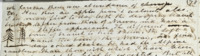
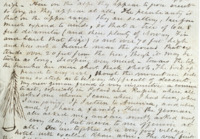
Hazard included sketches illustrating the interesting characteristics of Swiss trees in Letter No. 22 from September of 1857:
“I saw many firs to day with the drooping branch but they differ from those of Norway and have a stiffer appearance. The different illegible form of branch is here shown. The left hand tree being the Norway" (p. 78).
"Here in the Alps [trees] appear to grow erect so long as they appear at all. The peculiarity is that on the upper range they are scattering, Insofar much exposd to winds, so that a tree of 6 or 8 feet diameter (and there [are] plenty of Norway Fir and Larch that size) is not over 70 feet high and has not a branch near the ground that extends over 20 feet from the tree, though it may be twice as long, drooping very much. Towards the top the branches are more short thick shoots" (p. 84).
Hazard enclosed leaves, flowers, and seeds in Letter No. 23 from October of 1857:
“I enclose 4 leaves from the height above this town [Neuchâtel, Switzerland] . . . “I found while walking many wild sweet herbs of which I enclose seed . . . At the summit [of the Rigi] is no vegetation but grass and few flowers. I enclose some Daisies therefrom . . . From a portion of the “fallen Mountain” I send some yarrow”
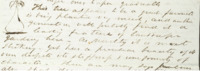
Letter No. 23 also includes sketches on several pages, including a detailed description of the grape stalks in the vineyards of Switzerland:
"The plants are nearer than corn is planted with us, not over 2 1/2 feet apart each way, middle status, One cannot walk between the rows without hitting the vines. The stumps of these are rarely over one foot high, have generally 3 prongs from each about 3 feet high. These are cut down to the prongs again every year. The stumps are covered with moss, and look very old + lifeless, and frequently 3 or 4 inches in diameter. The sprouts are all tied together around a short take, and each step produces from 6 to 15 bunches of fruit, generally, though cases are frequent where only one or two bunches are to be seen on a vine, while on others are 20 fine clusters.” (p. 10).
Brazil
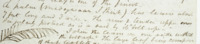
In Letter No. 4 (second series) from December of 1866, Hazard drew sketches of several plants:
"This tree appears to be a great favorite, is being planted very much, and another generation will probably find it a leading feature of landscape gardening here . . . A novelty it is most striking, yet has a peculiar beauty of its own despite its stiffness + uniformity of character" (p. 7).
"A palm (Madagascar I think) [in the Public Gardens] has leaves about 7 feet long and 3 wide. The new + tender upper ones singularly [illegible] as is a sail by its “bolt rope.” I show the leaves on one side “the bolt rope.” The large leaves being composed of sharp leaflets as represented" (p. 16).
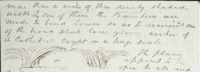
[regarding a garden outside the palace] "Very little [of] interest excepting great avenues of Bamboo, which are in bunches [illegible] say 15 by 12 feet each in which the bamboo is so close together as faggots, and are 50 feet high, the clusters big but a short distance apart. They droop at top or necessarily diverge and meet overhead, are not stiff but graceful and of fine green, stem and all. They do probably more than a mile of these dimly shaded walks. In one of them the Bamboo are made to bend lower so as to remind one of the hard short low gloomy arches of a Cathedral Crypt on a huge scale" (pp. 19-20; sketch on p. 20).
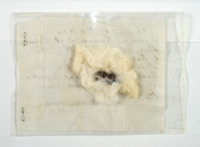
With Letter No. 5 (second series) from January of 1867, Hazard enclosed a sample of cotton:
"Sample of Cotton Grown in Province of St. Paul Brazil. Next south of that of Rio de Janeiro. Probably the best sent to the Brazilian Industrial Exposition at Rio, 1866, just closed"
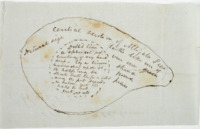
With Letter No. 7 (second series) from March of 1867, Hazard included a large sketch of an "alligator pear" (avocado):
"Central section of Alligator Pear looks like one of our own green skind round pears. Dotted line [shows] a spherical pit. Consistency of very hard soap. lay a linen handkerchief upon it, the hdkf. may be struck with knife or [illegible] and the pit severed in halves, yet the hdkf be not cut at all"