Land
Hazard also recorded detailed descriptions of the land he observed. He noted the size and shape of the mountains, hills, cliffs, and islands he observed, as well as some of his poetic impressions of these formations:
Ireland and Wales
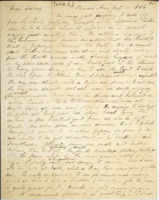
In this letter from his Atlantic crossing in July of 1856, Hazard describes the views of Ireland, Wales, and their surrounding islands:
"We are just about to pass Tusca Light a very graceful structure on a tiny sort Island of Rock, a very dangerous point. “Tara” a beautiful mountain conc* just above Wexford I was first discover, it looks like Sugar loaf hill at Wakefield magnified . . . A high castle, villages + villas, a belt of silver all along shore formed by the reflection of from the calm water in lee of the land, Beaches, with their sand cliffs that furiously sparkle in the distance when the sun happens to shine upon them (which it does not at all where we are the last 2 hours, though the earlier moon was almost [illegible] with it) combine in the inspiration of varied pleasing emotions . . . Beyond are mountains beautiful to see. These are the hills of Cambria, Wales, and it is with no ordinary sensation that I for the first time lay my eyes along the noble coast of glorious Britain. From the midst of a dozen peacks clustered close around him Cloud Capped Snowden rears his head as if to catch a last glimpse of the Wicklow range just singing in the distance of the receding coast of Ireland on our west. Holly Head is just in sight in advance, while in Carnavon Bay which we are just along the entrance of, several ships lie lazily on the unruffled mirror of its water"
"The Island at the entrance of Cardigan Bay on one side and Caernavon Bay on the other is a fine object and resembles a miniature of it on the West side of Block Island. One portion of the Wicklow Mountains reminded me of some on the West side of Lake Champlain while others of them and some in Wales also call to mind the peaks of Otter [Virginia] . . . We have just passed Holy Head, it is a cold rock of some 4 or 300 feet in height with an unmistakably irregular and sharp reflection against the sky, veering solid solid rock . . . very close to it is a little Island of rock perhaps 100 feet high with a revolving light on the summit"
*possible corruption or misspelling of Irish "cnoc," meaning "hill"
Scottish Highlands
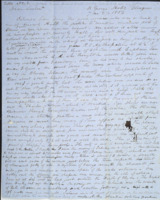
In this letter from July of 1856, Hazard remarks on the striking geography of the Highlands:
“High hill + lofty peaks near by on our right, Ireland and the mull of Cantyre in the distance along our left while the noble Island Carig of Aisla Ailsa stands in solitary grandeur a few miles ahead exactly on our course. It rises, a sort of outpart of the Highlands, perpendicularly from the water except a little shingle beach around it and a small plain extending from one side of it (the lee side) supposed to have been formed from the debris of the rock blown by the wind which prevails in one course here like our South west . . . We now came near to the Isle of Arran, presenting some great heights sloping gradually to the shore show as beautiful farms as ever I saw lined the gentle green declivity. (Aisla above the cliffs has a thin soil that is beautifully verdant with grass but which stock will not eat)"
“The Highlands present some of the most singular + extraordinary outlines against the sky I have ever seen. On some of a peculiar shade rested that imparted unspeakable richness and effect while the sharpness of the outline fairly spoke of the very blades of grass and pebbles which formed them.”
Wales
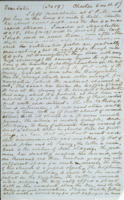
In this letter from June of 1857, Hazard observes the qualities of the land in Holyhead and Anglsey, Wales:
"When I passed Hollyhead on the Aria nearly eleven months ago, I was amazed at its richness of color, and clearly defined, sharp outline, and then felt as if I must go to its summit some day. I did this afternoon. Its covering of heather, accounts for its richness and its rock for the outline, I enclose some blue flowers from the apex, whence I had a fine view of the mountains of Wales (Carnavronshire, South to Bardsly Island distinctly) . . . A great deal of Angelsea* generally rather flat, lay before me. This nob of Hollyhead 500 feet high is cute off as it were from the other land by a low swail exactly similar to that which separates the Bateman farm on the West from the rocks on the East of it, which are on the drive to that farm. The rocks too on the east side of that swale are remarkably like those on the East side of this. [Prices?], Neck, and Rocky farm scenes are all about her in that neighborhood and castle hill too. Here however the rocks are more enriched and more or less covered by heather.”
Switzerland
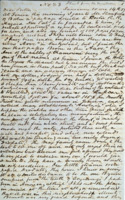
In this letter fom October of 1857, Hazard depicts picturesque scenes of Mont Blanc and the Alps:
"Mount Blanck was very grand beyond and the calm morning left the lake a shot of silver beautiful to see . . . All is calm as possible and the mountains sleep in the mists that half hide them at times far beyond the southern shore . . . Such a view of mountains is probably not elsewhere to be seen in Switzerland. The greater alps from Greyfraw on the left (indeed several further left also) and Mount Blanck on the right, are all embraced in one grand view . . . To crown all the scene cloud with a fine sunset framed by two high hills.”
The banks of the Danube
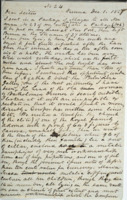
In this letter from December of 1857, Hazard describes the alluvial plains and cliffs he observed while traveling down the Danube:
"I think we have passed no spot yet (below Perth) where alluvial is not one side or the other of the stream, though hills are frequently on or near, one of the rivers margins . . . Some of the cliffs are of indurated yellowish clay and perfectly vertical (apparently) sometimes fully 200 feet in height much resembling those about Natchez [Mississippi]. They are generally much lower than this In some of them perforations are very numerous which I suppose to be the retreats of swallows Kingfishers etc. Nearer the surface of the stream, are others; probably of Craw fish. The river is gradually undermining some of the high cliffs, which settle often in square masses, that sometimes resemble tall castles."