Livestock
Hazard's attention to animals extended to domesticated varieties as well. In 1863, he sent a specimen of wool to the Museum of Comparative Zoology at Harvard, receiving a reply from director and naturalist Louis Agassiz: "This seems to be quite an unusual mode of growth of wool though I have recently received several specimens of it resembling the one you have had the kindness to send me . . . They have been put up in our Museum under your name."
Below are examples of Hazard's observations of the livestock of the countries on his travels:
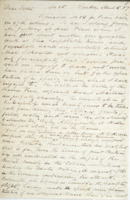
England
In this letter from March of 1857, Hazards recounts a story of farm life:
“I had an opportunity of seeing a rat catcher with two ferrets ridding the poultry yard of rats that were taking the young chickens to their den under a long pile of small wood + brush. The ferrets are much larger than our weazel, have long hair + fur, are soft like a rabbit and not hard like our weazel + mink. They are bred by their proprietors for this purpose, and appeared rather lazy and indifferent. They drove the rats out where the terrier could take them. I saw a ferret take hold of a rat, but only from sense of duty apparently. He had little heart in it, and only pulled out some hair by which the rat escaped ___to the dogs.”
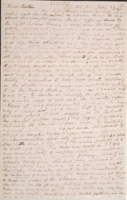
Norway
In this letter from June of 1857, Hazard describes the his impressions of Norwegian livestock:
"These animals are very intelligent docile as well as intelligent, their eye is bright as an Eagles . . . I saw a woman driving a herd counting cows, a few sheep and goats, to the house, I also met another lot of goats. I presume enough sheep, only are apt for domestic purposes . . . The ponies are generally hardly so large as the famous New Port chief.”
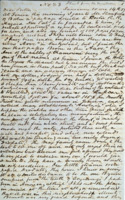
Switzerland and Germany
In this letter from October 1857, Hazard observes the qualities of the livestock in Switzerland and Germany:
“A single cow, or ox is a common team here, and draw a good heavy load . . . A couple of sheep I met flocks of sheep were nearly all (say 19/20) black . . . The cows of this valley (some 50 miles long) are the heaviest looking big on an average I have ever seen. They are common also in some other portions of Switzerland. All fat, look like oxen . . . Cattle, horses, sheep, goats, cats, of Switzerland are all gentle, and sleek looking. I have not seen a lame or broken down horse not one that appears to be old.”