Descriptions of flora
Joseph Peace Hazard was deeply interested in plants, and according to his diary (held at the South Kingstown Public Library in Peacedale, RI), felt he had "given [his] life chiefly to Planting Trees and Travelling, at least such has been [his] taste and desire in a highly dominant degree."
Unsurprisingly, Hazard often commented on the flora he encountered on his travels. His vivid descriptions include the flowers, trees, and gardens he saw, and range from short, one-sentence comments to lengthy lists. Virtually all of his letters included observations on various plant life:
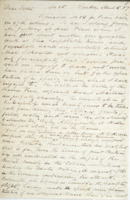
The English countryside
In this letter from March of 1857, Hazard describes the rural beauty he saw on his walks along the Thames and the grounds at Hale Place:
"The walks in the valley of the Thames there, especially toward Marlow are perfectly charming. The concentration of the “English” of rural beauty seems to be there.”
"At Hale place, yellow jasmines were in bloom in sheltered nook a week ago, I mean the kind that has a green black like Bloom, Gorse shows a few more flowers than it did a month ago, and the Peas which were then about an inch high on a south slope, are now only about 3 inches . . . The bramble are full of last year’s gum leaves, and the vigorous shoots show these leaves half as big as my hand and beautifully green. Wild willows, are opening their buds in silk floss. Shrub and like over “wispy willows” of the swamp. Crocus is in full golden glory, also the snow drop, both larger than with us. Honeysuckle is in very small leaf. Gooseberry just opening its green, Elder is in small struggling new leaves, Lilacks, Maples, (Sycamore Maple) and very many other shrubs . . . Daisies are already numbers upon the green grass Hazels beautiful with abundant greenish yellow catkins that shed plentiful pollen on being shaken."
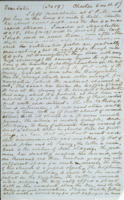
The gardens at Alton
In this letter from June of 1857, Hazard describes the gardens and grounds on a visit to Alton:
"There are groves of Rhododendrons in flower. I saw a cut leaved or Fern leaved Beech, some call it Fern leaved Oak, which I think is the same as the mystery in the yard, by the gate, of Red wood library, and not the English Hornbeam, as I at one time believed. Very many American trees are in the extensive plantings. In one part the trees are named, among these I saw “Pinus Rigida” “Pitch Pine New England” . . . The white or Silver pine is numerous. Spanish Chestnuts are just in small young flowers. The broom is still very beautiful by the road sides, and some gorse has flowers . . . In one of the waters of the grounds I saw very large water lilies, leaf and flower, like our own.”
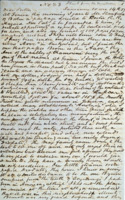
Switzerland and Germany
In this letter from October of 1857, Hazard admires the agriculture and trees he observed:
"I saw one Plumb tree, large as good sized apple trees, perfectly loaded down with blue fruit, though I noticed none on the multitudes of other plumb trees. Apples + pears are not all gathered yet . . . Sunflowers are cultivated in grounds of nice country seats in little groves, but are now out of flower . . . Sweet pumpkins of large size are numerous . . . Roses are on every hand, and scarcely more beautiful that the gorgeous splendors of our Indian creeper seen in all directions. Our horse chestnut too is in a most beautiful hue of sulfur, and some of the native maples are very pretty. The great tall blue aster, 5 or 6 feet high, is much cultivated also, as well as one as high and of a yellowish white . . . “[the changing leaves] range chiefly from the deep Russets of the Birch, to the delicate + charming straws of the Maples. The Cherry + Pear however are frequently scarlet or near so, and the rich green of Norway Pines, everywhere afford a rich contrast. Privet, Thorn, Elder, Ash Sweet Briar, Barberry, and many other things are yet full green, also some oaks. But all deciduous trees on the sides of the high hills are changed.”
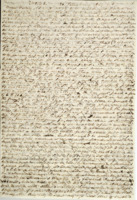
Russia
In this letter from August of 1857, Hazard describes the gardens, trees, and flowers he saw on his journey from Saint Petersburg to Moscow and around Russia:
“And at east station are gardens and nice walks to considerable extent, in which the beautiful scarlet berried elder and various shrubs Honeysuckle loaded with fruit abound. I saw many flowers among them Dahlias in bloom A deciduous Balm Gilead like ours + common throughout the North of this country where I have been are lilacs. Also Aspen Norway Fir and Red Pine with Birch make the chief of the copse for there is but little wood near the rail, and near Moscow is considerable oak, some of it tolerable size. The unusual shrubby willow and Alder abound, acres in a place are red with Phlox, and I saw white water lillies.”
"Evening primrose very abundant and two kinds of Mullein at least. The blossom of the tall kind which covers poor tracts as with us + looks like it, has its flowers large as are our Evening Primrose in diameter. Another is very delicate, though a mullein. A sort of white candytuft is common too. Wild geraniums, etc. Yarrow here as every where, always a welcome friend to me. The Cranberry tree wild and in the Station gardens, is often 8 or 9 feet high, its beautiful fruit almost [illegible] and red and amber like Solomon seal or Cornelian, as large as our cranberries and in great clusters. The scarlet berried Elder by its side 20 feet high sometimes, flourishes better as we get South and presents a sigh in its loads of coral that fairly rivals the Rowen of Scotland. I saw a pumpkin vine as a flower in one of the gardens. Both of the varieties of wild night shade that we have are wild here also I saw what I think to be Gentian as fine as our fringed and clover in the same manner the same heavenly blue, but I could not get out to see all those beautiful things bright and joyful”
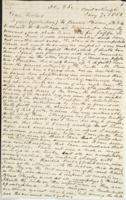
Israel
In this letter from January of 1858, Hazard lists the many varieties of plants he observed near Jaffa:
"In that section the ground abounds in wild flowers the ground is often painted with little ones. A Daisy like the English is common, both the white + pink tinged, but they are 3 times as large. The Almond tree is just blossoming, but the flower is like that of the plumb, not at all like the peach in colours. A very bright Scarlet Single Paeony is very rich and numbers in the fields, there also white ones and others of delicate purple. Many fields are fairly clothed in Lillies of various kinds, some of which are in clustered buds and appear to promise great beauty. Two or three kinds of gorse are seen, and what I suppose also to be varieties of heath. Among the western portion of mountains all is clothed in Evergreen. There I saw a variety of Mahonia several of the rich velvety thick leaved herbaceous plants. Laurels, and I think Kalmia, a sort of Holly. Evergreen both, both shrubs + trees that bear a beautiful and very long slender acorn. Myrtle trees, very rich and handsome 30 feet high + shrouding, at least I take these for Myrtle Besides countless I know not. Blackberry (evergreen here) is abundant, and there is a wild cherry. Tamarisk and Pride of China are on the plains. The country about Jaffa appears to have more fruit there variety of fruit than any country I know of. Olive orchards that look a thousand years old are every where even on top the rocky mountains. They are interesting but not a handsome tree. Grove after grove of oranges and Sour and Sweet Lemons + Limes golden with fruit, soon to gathered. Orchards of Almonds, Pomegranates, figs, Prunes, Date palms rising in all directions objects of highly picturesque beauty.”