Water
Hazard paid close attention to the characteristics and formations of the rivers, lakes, bays, and ocean on his travels. In a diary page from 1890, he recalled a "water spout" he observed on a previous journey to the Caribbean as "a grand and beautiful spectacle."
He often described the properties of the water itself both descriptively and poetically, and often compared the rivers he saw to the Mississippi River:
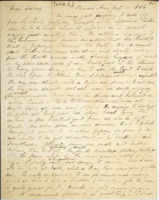
The Atlantic & St. George's
In this letter from the steamship Aria on his way from New York to Liverpool (July of 1856), Hazard describes the beauty of the ocean water, and later, St. George's Channel between Ireland and Wales:
"Came on deck at 9 P.M. after a good night. every thing looks better though still cloudy + North East wind. Occasionally the sun shines revealing the heavenly blue of the waters and the bright side of every thing. Not a sail is in sight, nor a line . . . The gulf weed like little patches of Arabesque in gold gilds with small spots (generally not larger than the hand) and richly contrasts with the deep pure azure ground of the water. It is full of little crabs who thus live and voyage in golden palaces."
"Here we are in the St. George's Channel where we see the high cliffs near Waterford, various ships, gulls flying over the peacefully quiet water (as if a river) just like our in appearance but with rather different movement. This morning has sunshine but withal a little hazy, but the Channell is so wide we could not see Wales if it was clear although we must be 8 or 10 miles form Ireland.”
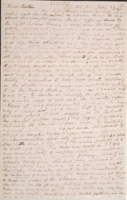
Norway
In this letter from June of 1857, Hazard remarks on the quality of the waters in the lakes and rivers of Norway:
"I have been struck with beauty of the water here. Green as emerald as we look into them, yet clear as crystal, they do not lose any transparency, in the colouring property."
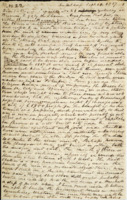
The Rhine
In this letter from September of 1857, Hazard describes his first impressions of the Rhine in Germany:
"After a late breakfast this morning I went to take my first look at the “Wide and Winding Rhine” I found it winding but only 320 yards wides at the Bridge of Boars which crosses it here, probably at the nearest convenient point. Its waters are dull, light green, and flow with a current more rapid than that of the Mississippi and weave a very impatient, uncontrollable aspect."
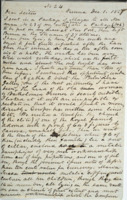
The Danube
In this letter from December of 1857, Hazard describes the Danube River:
"I think the waters of the Danube here are perhaps not turbid, but only a thick sort of green, I can [see] the bottom where it is 2 or 3 feet deep.”
"Most of the way thus far is very singular in appearance to the Mississippi on a small scale. The Rise + fall of the river is narrow not over 12 feet apparently. It is winding with perpendicular caving alluvial shores on the concave of the reaches with low point on sand bars opposite to them. Low flat wooded islands abound, and the alluvials appear to be rich and extensive . . . I think we have passed no spot yet (below Perth) where alluvial is not one side or the other of the stream, though hills are frequently on or near, one of the rivers margins. A very large portion of the lands near the river appear to be waste land, in consequence of the overflow to which they are subject.
“The river is winding in "reaches" like other alluvial streams, and is yet not wider than Red River above Alexandria [Louisiana]. The banks are frequently laid with a sort of thatch of willow twigs etc, to protect them from the abrasion of the water, though the current (at the present low stage at least) is very gentle.”
The Amazon
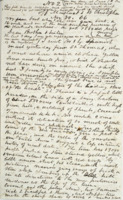
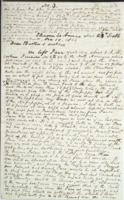
In these two letters [Nos. 2 and 3 of the second series] from the end of 1866, Hazard describes the Amazon River, making several comparisons to the Mississippi:
"[We] are now in the Amazon with its 3 mile current of grey muddy water like that of the Mississippi . . . We are at Para having enjoyed the glories of tropical vegetation + forests so much heard of— Exceeding any thing I ever before saw although the general appearance of this is that of the Mississippi on a wider scale. In fact we have passed through an immense lake abounding in islands" [No. 2]
“The current is very strong at Para where the river is 4 fathoms deep + 3 miles wide from the main bank to the large island, and the tide rises there 15 feet (spring tides). The water is yellowish gray like that of the Mississippi but less turbid in a glass . . . It is a mighty lake or Bay at Para only rendered river like by Islands, and all the shores we see present a wilderness of majestic beauty and grandeur of apparently everlasting and interminable forest of the richest possible effects of Arboreal wealth . . . The banks of the river are also sloping with beach shore and not vertical + caving like those of the Mississippi.” [No. 3]